There is no fixed water filter installation cost in South Africa, because the price depends on your water source, what a water test says needs removing, how much of the property you treat and how easy the install spot is to reach. As a rough guide, the equipment alone runs from under R1 000 for a basic under-sink kit to more than R10 000 for a borehole system with iron removal and UV, before installation and running costs.
The ranges below come from South African retail listings, not from a Water Filter Systems price list. We test before we specify and size every system to the site, so use these ranges to sense-check a quote rather than replace one.
Indicative equipment prices in South Africa (2026)
These are indicative equipment prices seen at several South African water treatment retailers in October 2026. They exclude installation, plumbing materials, delivery and water testing, and are rounded generously.
| Equipment | What it is for | Indicative price (excl. installation) |
|---|---|---|
| Under-sink sediment and carbon kit, 2-3 stages with tap | Better-tasting drinking water at one tap | R600-R2 500 |
| Under-sink reverse osmosis unit, 5-7 stages | Dissolved salts, nitrates and metals at one tap | R1 800-R4 000 |
| Whole-house 3-stage 20-inch sediment and carbon set | Grit, chlorine taste and smell at every outlet | R2 400-R6 000 |
| Whole-house 3-stage set with UV steriliser | Borehole, wellpoint or tank water used indoors | R4 400-R9 000 |
| Standalone household UV steriliser | Bacteria control after filtration | R1 800-R5 500 |
| Iron and manganese backwash filter | Orange or black staining from borehole water | R6 000-R25 000 |
| Water softener | Hard water scaling geysers and appliances | R6 000-R26 000 |
What drives the price: your water, the test and the scope
Your water source
Cape Town's municipal water is treated to the national drinking water standard, SANS 241, so filtering it is about taste, smell and sediment from older pipes or after supply interruptions. That is the cheapest scenario: sediment and carbon, under the sink or where the water enters the property.
Borehole and wellpoint water is untreated, so what it needs depends on the ground it comes from. Borehole water filtration can call for sediment filtration, iron and manganese removal, carbon and UV before the water is fit to drink, which puts it at the top of the table. Rainwater sits in between: it collects debris, sediment and bacteria from the roof and tank, so indoor use generally means a pump, sediment filtration and UV.
What the water test shows
On borehole jobs, a laboratory test against SANS 241 comes first, because it decides which stages you pay for. One borehole may only need sediment filtration and UV, while another needs an iron removal vessel that can cost more than the rest of the system combined. The last two rows of the table only apply when a test calls for them. Our borehole water treatment guide explains how each test result maps to a treatment stage.
Point of use or whole house
A point-of-use system treats one tap, usually in the kitchen. An under-sink water filter with sediment and carbon stages is the lowest-cost route to better drinking water, and reverse osmosis is the step up when dissolved solids are the concern. A whole-house system treats everything entering the property, including showers, the geyser and the washing machine, so it uses larger housings, takes longer to install and goes through bigger cartridges. Many homes combine the two.
Flow rate and household size
Whole-house equipment has to keep up with the busiest moment of the day. Common 20-inch three-stage sets and 55-watt UV units are rated at roughly 2 700 litres an hour. If two showers, the washing machine and an irrigation line run together, or the borehole pump delivers more than that, the housings and UV have to be sized up and the price follows. Undersized housings are a common reason a new system seems to have taken the pressure away.
Site conditions that change the quote
Plumbing access and cabinet space
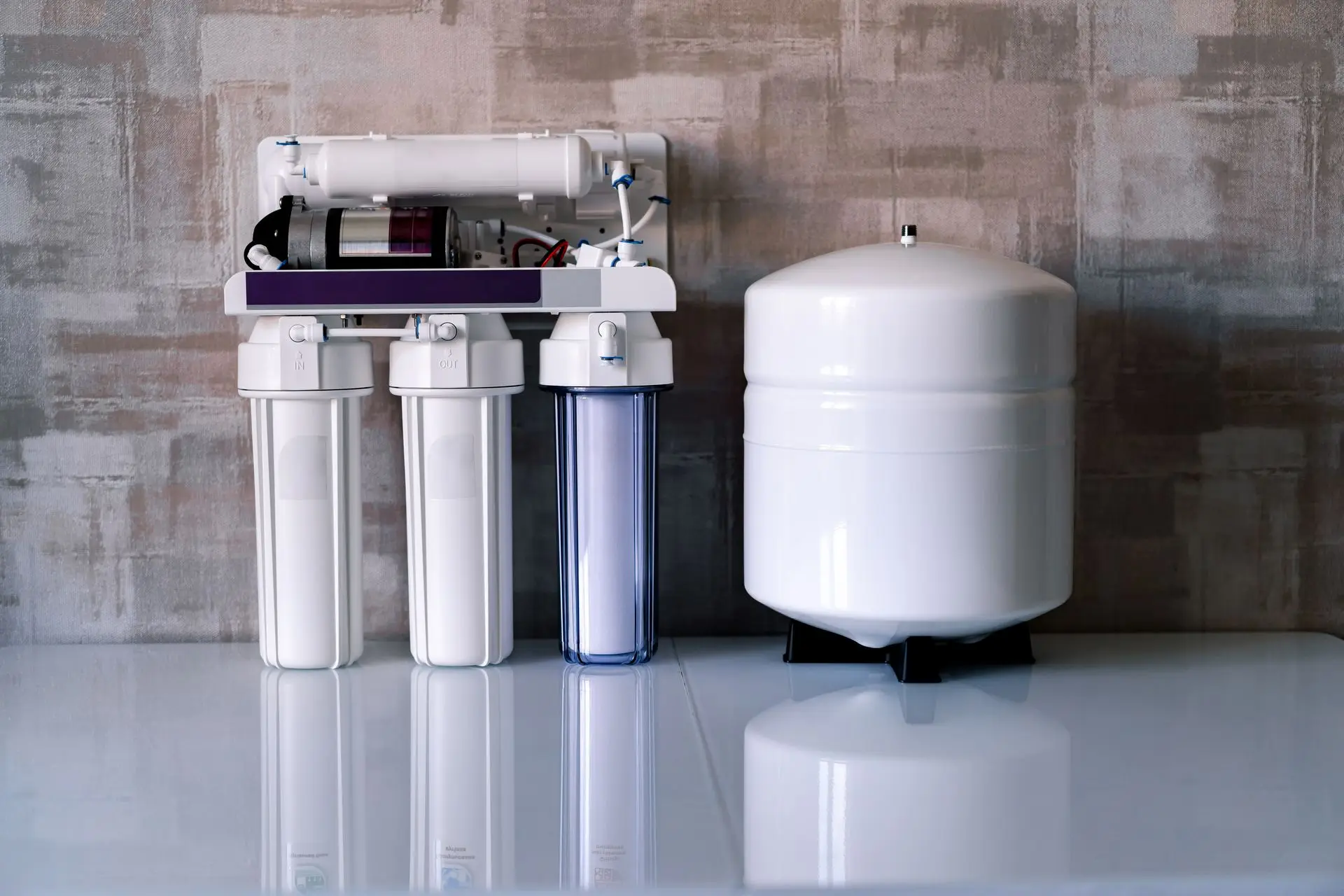
An under-sink filter in a cabinet with a cold-water isolating valve and room to work is a quick job. A tap hole through a granite worktop or a crowded cabinet adds time. Reverse osmosis also needs a drain connection and space for its storage tank. For whole-house systems, it comes down to where the main line enters: a meter on the boundary, a pipe buried in a wall or a spot far from a plug point all change the labour and materials.
Pumps, pressure tanks and booster pumps
Filtration always costs some pressure. A correctly sized system on a municipal supply should not be noticeable, but reverse osmosis needs good pressure, and the same RO units are sold with and without a booster pump for low-pressure homes. In the listings we checked, the pump version cost roughly R450-R700 more. Borehole and tank systems rely on the pump and pressure tank already on site, so if those are tired or too small, they become part of the job.
Iron and manganese stages that backwash
Iron and manganese removal usually means a tall media vessel that cleans itself by backwashing instead of a disposable cartridge. It needs a drain for the backwash water, enough flow from the pump to clean the media, and either a manual valve or an automatic control head that needs power. In current listings, an automatic head added roughly R2 000-R3 500 over a manual valve on the same size of vessel. Softeners work in a similar way and also use salt.
UV needs power
A UV steriliser runs around the clock, so it needs a plug point close by. It only disinfects while it has power, so where power cuts are a risk, plan for backup power or a flow cut-off that stops untreated water reaching the taps while the lamp is off.
Commercial installations: downtime and compliance
For restaurants, cafés, guest houses and offices, systems are sized for higher flows and often for specific equipment such as coffee machines and ice makers, and the work may need to happen outside trading hours. Bypass valves add a little to the job but let cartridges be changed without shutting off the water.
Food businesses also have a compliance angle. South Africa's hygiene regulations for food premises (R638) define water as potable water that complies with SANS 241, so a business running on borehole water needs testing, and treatment where the test calls for it, to meet that standard. Our commercial water filtration page covers the planning in more detail.
Running costs and total cost of ownership
The sticker price of a water filter is a one-off. The consumables are not, and over a few years they can match or exceed what you paid for the equipment. Typical replacement intervals, with indicative 2026 retail prices, are:
- Sediment and carbon cartridges: every 6 to 12 months, and more often on borehole or tank water. Standard 10-inch cartridges were listed at about R20-R150 each and 20-inch Big Blue cartridges at about R250-R550 each.
- Reverse osmosis membranes: every 2 to 3 years, with the pre-filters changed every 6 to 12 months. Household membranes were listed at about R200-R500.
- UV lamps: once a year, even if the lamp still glows, because its UV output drops with use. Household lamps were listed at about R450-R1 000.
Water and power count too. Reverse osmosis sends some water to drain, backwashing filters and softeners use water to clean themselves, and UV units and booster pumps draw electricity all year.
As an illustration, a whole-house set with UV that needs a three-cartridge change once or twice a year (about R600-R700 a set) and a new lamp every year would spend roughly R4 000-R12 000 on consumables over five years, the same range as the equipment itself. That is why a cheap unit with odd-sized cartridges, or a borehole system without a sediment stage protecting the finer filters, often costs more in the long run. Standard housing sizes keep replacement water filter cartridges easy to find, and a filter changed on schedule keeps doing its job.
DIY or professional installation?
Some of this is genuinely DIY territory. Water filter jugs and countertop filters need little or no installation, and if you are comfortable working under a sink, a basic under-sink sediment and carbon kit comes with its tap and fittings. It stops being a DIY job when:
- the system goes on the main line into the house, where a leak or a wrong fitting affects every tap
- a borehole, wellpoint or tank is being tied into the household plumbing
- it needs a drain connection (reverse osmosis, backwash filters and softeners) or a new plug point (UV and pumps)
- the stages and micron ratings have to be chosen from a water test
There are rules as well. The City of Cape Town's Water By-law requires plumbing installation work to be done by a qualified plumber, requires boreholes and wellpoints to be registered with the City, and requires alternative water systems, especially any that connect to the municipal supply, to be approved by the City. The most expensive DIY outcome is a system installed in the wrong order, too small for the flow or missing a stage the water needed, which then has to be redone.
How to get an accurate quote
Sending the right details up front gets you a firmer figure and fewer surprises on the day:
- Water source: municipal, borehole, wellpoint, rainwater tank or a mix
- Property type and size: house, flat, smallholding or business, plus the number of people and bathrooms
- Area: your suburb or town
- Photos of the install spot: the cabinet under the kitchen sink, where the main line enters, or the borehole pump and pressure tank
- Existing test results: a SANS 241 laboratory report if you have one
- The problem you want solved: taste, staining, scale, cloudy water or drinking-water safety
Businesses should add their trading hours and the equipment that uses the water. If you want to understand the stages first, how water filtration systems work explains each one in plain terms.
Frequently asked questions
Is a whole-house water filter worth the extra cost?
It depends on the water. On a treated municipal supply, a whole-house filter improves taste and smell at every tap and keeps sediment out of the geyser and appliances, but an under-sink filter is cheaper if drinking water is all you care about. On borehole or tank water used indoors, treating the water where it enters the property is usually the practical starting point.
How often do water filter cartridges need replacing?
Carbon cartridges are typically changed every 6 to 12 months, sediment cartridges when they discolour or the pressure drops, reverse osmosis membranes every 2 to 3 years and UV lamps once a year. Borehole and tank water usually shortens those intervals, because there is more for the filters to catch.
Can I get a quote without a water test?
On municipal water, usually yes: your water source, property type, area and a photo of the install spot are enough for a first recommendation. On borehole water, the test comes first, because it decides which stages the system needs.
When you want a figure for your own property, look at the options for home water filtration, then send your water source, property type and area through our get a quote page.