Rainwater is not safe to drink straight from the roof or the tank, because it carries bird and animal droppings, leaves, dust and residue from the roof itself. Rainwater filtration works in stages: screens and a first flush diverter keep the worst out of the tank, a sediment filter cleans what comes out, and carbon and UV are added when the water is meant for drinking. Inside the City of Cape Town, the City's rules keep rainwater for non-drinking uses in most homes, so households usually filter it for the garden, toilets and laundry.
Many Cape Town households installed tanks during the drought behind the 2018 Day Zero countdown. Most of the region's rain falls between May and August, so tanks fill in winter and stand through a long, dry summer.
Is rainwater safe to drink?
Not untreated. Rain is fairly clean when it falls, but the roof collects droppings from birds, rodents and lizards, along with leaves, dust and dead insects. The City of Cape Town also notes that quality depends on the roof material, the gutters and how close trees, bird roosts and industry are.
A Stellenbosch University study of 29 rainwater tanks in Kleinmond, sampled during the 2012 winter rains, found bacteria from groups that include serious pathogens, such as Legionella, Salmonella and Shigella. The researchers concluded that untreated harvested rainwater could pose a significant health risk, especially for children and people with weakened immune systems.
Rain is naturally slightly acidic, at about pH 5.6, and leaf litter in gutters makes run-off more acidic, which can corrode metal tanks, pipes and fittings. Old lead-based paint and bitumen coatings make poor catchments for drinking water. In storage, warm water can grow bacteria and sludge builds up, and the City notes that stored rainwater tends to be better in wet months than in dry ones.
Decide what the water is for first
The right rainwater filtration system depends on the use, and the gap between garden water and drinking water is wide.
| Use | Typical treatment | Cape Town notes |
|---|---|---|
| Garden and washing cars | Gutter guards and an inlet screen, plus a coarse filter for drip irrigation | Allowed with basic filtration and a sign at the outlet |
| Toilet flushing | Screens, a first flush diverter and a sediment filter after the pump | Plumbed systems need City approval and back-flow protection |
| Laundry | As for toilets, with finer sediment filtration | Treated rainwater, with City approval for the plumbing |
| Drinking, cooking and bathing | Screens, first flush, sediment, carbon and UV, plus laboratory testing | Check the current by-law position first |
The City of Cape Town's guidelines for alternative water say that rainwater, treated or untreated, may not be used for drinking, cooking or body washing, apart from approved Water Services Intermediary arrangements for larger developments. Inside the City of Cape Town, check the current by-law position with the City before plumbing rainwater to drinking taps, and elsewhere check your municipality's by-laws. The drinking-water stages below matter most on farms and smallholdings without a municipal connection.
On most suburban properties the sensible split is rainwater outside and in the toilets, and municipal water in the kitchen. If the taste of your tap water is the real issue, home water filtration on the municipal line is the simpler fix.
Before the tank: gutters, screens and a first flush diverter
The less dirt that reaches the tank, the better every later stage works, a principle our guide to how water filtration systems work explains.
Gutter guards and leaf screens
Gutter guards keep leaves out, and a leaf screen at the downpipe or tank inlet catches what gets past. The City's guidelines require a screen or filter where there is no first flush diverter: 800 microns (0.8 mm) is the general size, but 200 microns (0.2 mm) is best practice. Fit insect mesh over the inlet and overflow to stop mosquitoes breeding, and cut back branches over the roof.
First flush diverters and how to size them
A first flush diverter is a length of vertical pipe on the downpipe that catches the first, dirtiest water off the roof. In most designs a floating ball seals the chamber once it is full, so cleaner water flows on to the tank, and a small bleed valve drains it slowly before the next rain.
Sizing advice varies. Australian health guidance suggests diverting the first 20 to 25 litres from an average roof, while one Australian manufacturer works on 0.5 litres per square metre for a clean, open roof and 2 litres per square metre under trees or birds. That is 50 to 200 litres for a 100 m² roof. The dirtier the roof, the more you divert.
The City treats diverters as optional and notes that some installers find them wasteful where a good screen is fitted. They earn their place under trees, where birds roost or where the water is used indoors. Keep the bleed valve clear, or the chamber stays full and stops working.
Inside the tank: calm, cool and drawn from the right level
Sludge settles on the floor and some debris floats, so the cleanest water is usually just below the surface.
- Calmed inlet. The inflow pipe releases water gently near the bottom, so it does not stir up sludge and keeps the lower levels oxygenated.
- Floating suction. A pickup hose on a float draws water from just below the surface.
- Shade and an opaque tank. Light feeds algae and warmth favours bacteria. British Columbia's drinking water guidance flags a Legionella risk where stored water stays above 25°C, and the City recommends a shady spot.
- Sealed lids and screened openings. These keep out animals, insects and light.
- Overflow to stormwater. The City's guidelines send untreated rainwater overflow to stormwater, not the sewer.
After the tank: choosing a water tank filter, carbon and UV
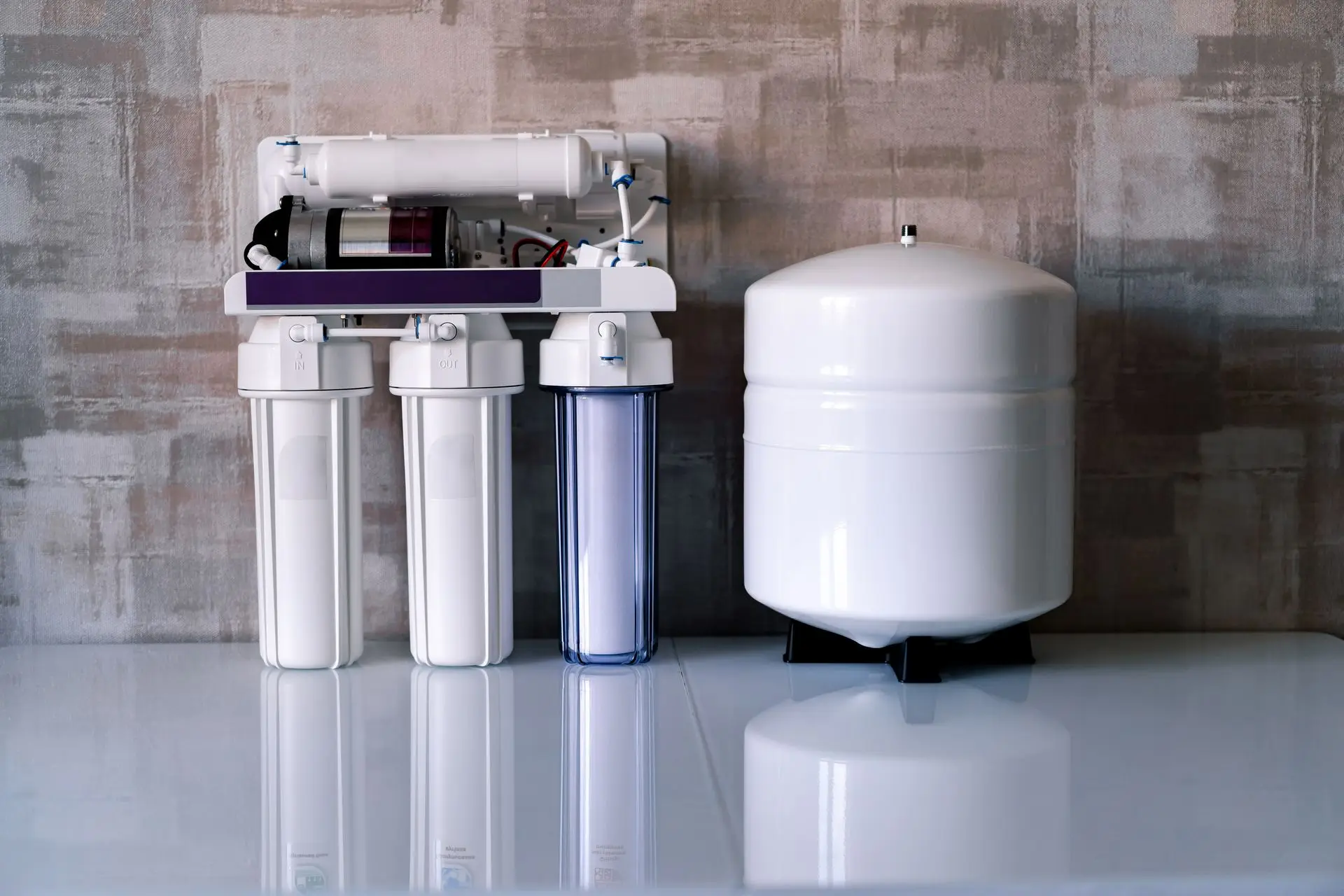
This is what most people mean by a water tank filter or a JoJo tank filter, and it answers how to purify rainwater for drinking: set stages in a set order, each protecting the next. Where a pump feeds the house, the cartridge housings normally sit after it, sized to its flow so pressure at the taps holds up.
Sediment filtration first
A sediment water filter is the core of every rainwater system, removing the grit, roof dust and organic particles that pass the screens. Tank water usually starts with a coarser cartridge. If the water goes on to UV, a finer stage of around 5 microns follows, because UV manufacturers typically specify it.
Carbon for taste and odour
Tank water can taste earthy or smell of leaf litter. A carbon water filter after the sediment stage improves taste and smell and reduces many organic compounds. It is optional for garden and toilet water and standard for drinking water. Carbon does not remove bacteria, and an unmaintained cartridge can grow its own, which is one reason UV goes last.
UV for drinking water, and planning for power cuts
A UV water filter inactivates bacteria, viruses and other microorganisms without chemicals, but only in clear water. Manufacturers typically call for turbidity below 1 NTU and UV transmittance above 75%, which is why sediment and carbon come first. The lamp is replaced every year, even if it still glows.
UV needs electricity, so plan for load-shedding and outages: if the lamp is off while water flows, untreated water reaches the tap. Put the UV unit and pump on battery or inverter backup, or fit a solenoid valve that stops the flow whenever the UV is not running. Some manufacturers also specify a few minutes' warm-up after power returns.
Cape Town rules for rainwater tanks
The City promotes responsible rainwater use, but its Water By-law and guidelines regulate the plumbing to protect the drinking water supply.
- Approval and registration. Plumbed-in systems, whether for irrigation, toilets or a washing machine, need an application to the City and an inspection, and alternative water installations must be registered.
- No cross-connection. Municipal and rainwater pipework must never be joined. Once rainwater is plumbed into the building, a reduced pressure zone (RPZ) back-flow preventer on the municipal supply is mandatory, or an approved air-gap tank. Non-return valves do not count.
- Labels and signs. Rainwater pipes are colour-coded or labelled (lilac in the City's guidelines), and the City's non-drinking water sign goes at the entrance and at each outlet.
Use a plumber registered with the City, and check the City's website for the current by-law and guidelines before you build.
Switching to municipal water when the tank runs dry
The two supplies may not be interconnected, so a simple changeover valve is out. One option is a municipal top-up into the tank through an air gap: a float valve discharging above the overflow level, with a gap of at least twice the supply pipe diameter and never less than 25 mm. The tank water is still non-drinking water. The other, for toilets, is to disconnect the municipal feed to the cistern while rainwater supplies it and reconnect it when the tank runs dry.
Tank cleaning, maintenance and testing
Keep to a simple routine.
- Before the winter rains: clean the gutters and screens and empty the first flush chamber, so the season's first fill is a clean one.
- Weekly while in use: check the tank, screens and diverter, as the City's guidelines ask.
- Every six months: inspect the roof, gutters and inlet screens, more often under trees, in line with Australian health guidance.
- Every one to three years: check for sludge and desludge when needed, taking the sludge to a municipal waste site rather than the sewer, as the City asks.
- Cartridges and lamps: sediment when the pressure drops, carbon typically every six to twelve months and the UV lamp yearly.
Testing rainwater before you drink it
Have the tank water tested at a SANAS-accredited laboratory before the system is designed, then test the treated water at the tap. SANS 241, the South African drinking water standard, requires that no E. coli be detected in a 100 mL sample and sets limits for turbidity, pH and metals such as lead and copper. Retest after any change to the roof, tank or treatment, and in late summer, when stored water tends to be at its worst. Our guide to water quality in South Africa gives the wider picture.
Frequently asked questions
Can you drink rainwater from a JoJo tank?
Not untreated. Tank water needs screening, sediment filtration and UV, and a laboratory test against SANS 241, before it is fit to drink. Inside the City of Cape Town, check the by-law position with the City first.
What filter do I need for a rainwater tank?
For garden and toilet use, a leaf screen at the inlet and a sediment filter after the pump. For drinking water, add a finer sediment stage, carbon and UV, all sized to the pump's flow rate. A water test sets the right micron ratings.
How often should a rainwater tank be cleaned?
Check it weekly in use, clean gutters and screens before winter and every six months, and desludge every one to three years.
Planning rainwater alongside a municipal or borehole supply? Our custom water filtration service plans mixed sources stage by stage. Send your water source, property type and area through the quote form and we will help you turn it into a practical specification.